
Launching a supplement brand can be exciting, but turning a promising idea into a product customers trust takes planning, money, and patience. New businesses must consider formulas, ingredients, packaging, quality testing, regulations, and inventory before making their first sale. Managing everything independently can stretch a small team thin.
That is why private label supplement manufacturing deserves serious consideration. Instead of building a factory or developing every formula from scratch, startups can work with an experienced manufacturer to produce supplements under their own brand. This approach can simplify important steps while giving founders more time to understand customers and build a business.
In this article you will learn:
What Does Private Label Supplement Manufacturing Mean?
Lower Barriers to Getting Started
A Faster Route From Idea to Launch
Products That Fit Different Customer Needs
Quality Becomes a Shared Priority
More Time to Build Your Brand
Room to Test and Grow
What Does Private Label Supplement Manufacturing Mean?
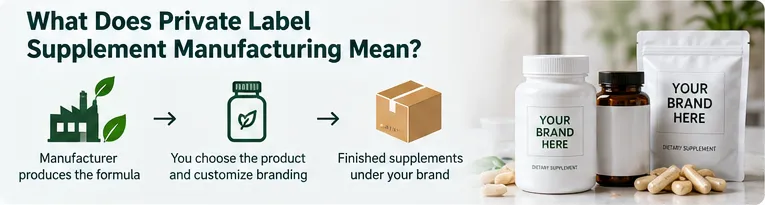
In a typical private label arrangement, a manufacturer offers existing or adaptable supplement formulas that another business sells using its branding. The company decides on appropriate items to be ordered, negotiates on packaging and labeling specifications, and then makes the order.
Private Label Supplements Manufacturing is sometimes used as a search term for this service, although providers may offer different levels of customization. Some supply standard formulas with branding options. Others allow adjustments to ingredients, flavors, serving sizes, or packaging. Always confirm what is actually included before committing.
Lower Barriers to Getting Started
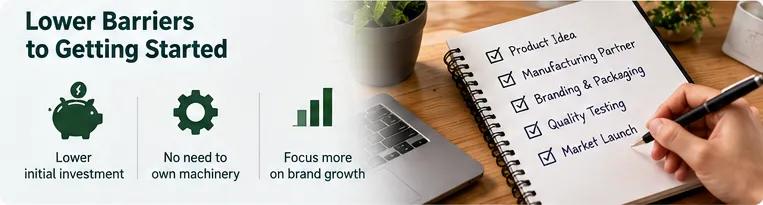
Building a manufacturing facility requires equipment, skilled employees, production systems, testing procedures, and substantial capital. For most new brands, that investment is difficult to justify before demand is proven.
With private label manufacturing, startups can access established production capabilities without owning the machinery. Costs do not disappear: product orders, design, testing, shipping, marketing, and compliance still matter. However, avoiding a factory investment can leave more room in the budget for customer research and brand development.
Ask potential partners about minimum order quantities, setup fees, payment terms, and storage requirements. These details determine whether an opportunity fits your actual startup budget.
A Faster Route From Idea to Launch
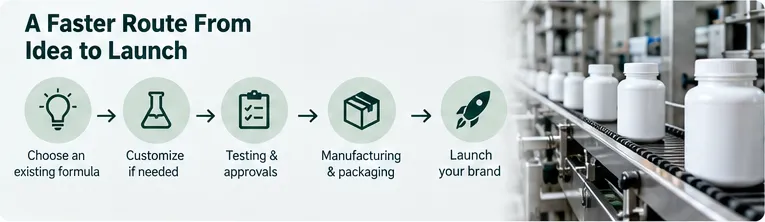
Creating a new supplement formula can involve research, ingredient sourcing, stability assessments, trial batches, and multiple revisions. Selecting an established formula may shorten development, especially when the manufacturer already understands the production process.
That speed is valuable, but timelines are never automatic. Label approvals, ingredient availability, production schedules, and testing can still create delays. Request a realistic timeline for samples, packaging, manufacturing, quality checks, and delivery.
Launching sooner is useful only when the final product meets your standards.
Products That Fit Different Customer Needs

Supplement customers have different preferences. Some appreciate convenient capsules, while others prefer powders they can mix into a drink. A manufacturer with multiple formats can help a startup test which experience suits its intended audience.
For capsules manufacturing, discuss capsule materials, serving size, ingredient compatibility, and how consistency is checked across batches. For powder manufacturing, explore flavor, mixability, scoop accuracy, moisture protection, and packaging options.
Do not launch several products simply because they are available. Begin with a focused range based on a clearly defined customer need. A smaller catalog is often easier to explain, manage, and improve.
Quality Becomes a Shared Priority
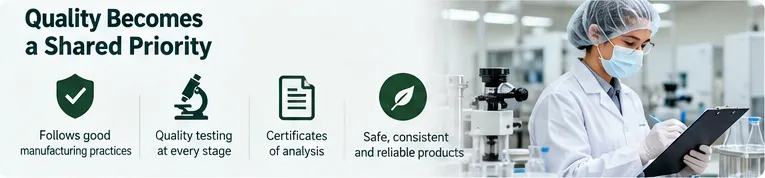
Customers expect supplements to contain what the label promises. That makes manufacturing quality a business essential, not merely a marketing advantage.
Ask whether prospective manufacturers follow applicable good manufacturing practices and how they qualify suppliers, verify ingredient identity, prevent contamination, and document production. Understand which tests are performed on raw materials and finished products. Where appropriate, request certificates of analysis and ask what those documents actually cover.
A reliable partner should explain procedures clearly rather than relying on broad statements such as “premium quality.” Independent testing may also be worth considering depending on your product and market.
Remember that outsourcing production does not remove your responsibility to sell a compliant, accurately represented product.
More Time to Build Your Brand
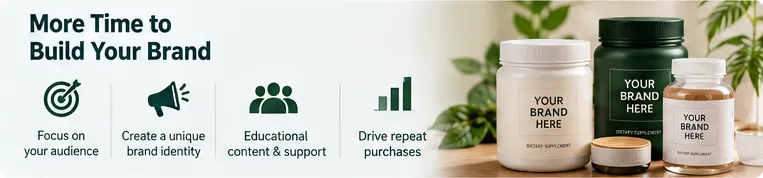
A startup rarely succeeds because of manufacturing alone. Moreover, it must have a reason why people should pick it from all the options available.
Private label supplements can give founders more time to work on positioning, educational content, customer service, distribution, and repeat purchases. You can create a recognizable visual identity, communicate who the product is for, and explain its features in straightforward language.
Avoid making unsupported promises about health outcomes. Trust grows when labels, marketing, and customer support communicate consistently and honestly.
Room to Test and Grow

One of the biggest challenges for new supplement businesses is predicting demand. Ordering too much can tie up cash in unsold stock, while ordering too little can cause frustrating gaps in availability.
A flexible manufacturing partner can help you plan sensible launch quantities and discuss reorder lead times. Track sales, returns, customer feedback, and inventory turnover before expanding your range.
As demand develops, ask whether your supplier can support larger orders, new formats, improved packaging, or more customized formulations. Growth works best when decisions follow evidence rather than excitement.
Know the Limits Before Choosing

Private labeling is not the perfect answer for every business. Ready-made formulas can make it harder to differentiate a product through ingredients alone. Manufacturers may also impose minimum orders, restrict packaging choices, or serve competing brands using similar formulas.
Compare several suppliers before deciding. Ask about formula ownership, exclusivity, ingredient sourcing, testing costs, labeling support, complaint handling, and what happens if a batch fails quality checks. Review contracts carefully, including responsibilities for recalls and product issues.
Also check the legal requirements in every market where you intend to sell. Rules for ingredients, product claims, labels, and registrations vary by country. An experienced manufacturer can provide useful guidance, but your business should seek qualified regulatory advice when needed.
A Practical Starting Point
Private label supplement manufacturing offers startups a realistic way to enter a demanding category without taking on every production task themselves. Its greatest advantages are access to established capabilities, potentially faster development, and more attention for customers and branding.
Success still depends on choosing products thoughtfully, checking quality, understanding total costs, and communicating responsibly. Start with one clear audience, evaluate manufacturing partners carefully, and build a brand people have good reasons to trust for years ahead.
Frequently Asked Questions (FAQ)
What is Private label?
That is why private label supplement manufacturing deserves serious consideration. Instead of building a factory or developing every formula from scratch, startups can work with an experienced manufacturer to produce supplements under their own brand.
What are the most important things to remember?
The key points are: What Does Private Label Supplement Manufacturing Mean?, Lower Barriers to Getting Started, A Faster Route From Idea to Launch, Products That Fit Different Customer Needs, Quality Becomes a Shared Priority.